
A Bachelor of Education (B.Ed) degree is the first step toward a successful teaching career. However, securing a teaching job requires more than academic qualifications. Whether you’re applying to a private school or preparing for a government school recruitment process, performing well in the interview is essential.
In this guide, you’ll learn practical tips, common interview questions, preparation strategies, and mistakes to avoid so you can confidently crack your B.Ed interview.
Why B.Ed Interviews Matter
Schools look beyond your degree. Interviewers assess your teaching skills, communication, classroom management abilities, confidence, subject knowledge, and passion for education. A strong interview performance can significantly increase your chances of getting selected.
Understand the Difference Between Private and Government School Interviews
Private School Interviews
Private schools generally focus on:
- Communication and spoken English
- Subject knowledge
- Classroom management skills
- Teaching methodology
- Personality and confidence
- Demonstration (Demo) class
- Adaptability and creativity
Government School Interviews
Government teaching recruitment often emphasizes:
- Academic qualifications
- Performance in Teacher Eligibility Tests (CTET, TET, etc.)
- Subject expertise
- Educational psychology
- Teaching aptitude
- Current educational policies
- Interview or document verification (where applicable)
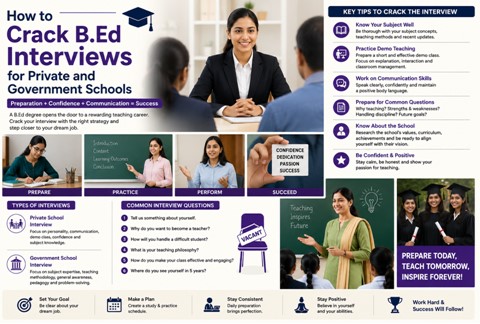
Top Tips to Crack a B.Ed Interview
1. Know Your Subject Thoroughly
Revise the core concepts of your teaching subject. Be prepared to explain difficult topics in a simple and engaging way.
2. Improve Your Communication Skills
Teachers are expected to communicate clearly and confidently. Practice speaking in a calm, positive, and professional manner.
3. Prepare for a Demo Class
Many private schools ask candidates to conduct a short demonstration lesson.
Your demo should:
- Begin with a proper introduction
- State clear learning objectives
- Use interactive teaching methods
- Ask students questions
- Conclude with a quick recap
Keep your lesson engaging and student-centered.
4. Learn Classroom Management Techniques
Interviewers often ask how you would handle situations such as:
- Disruptive students
- Slow learners
- Large classrooms
- Student discipline
- Parent interactions
Provide practical, positive, and solution-oriented answers.
5. Stay Updated with Educational Policies
For government teaching interviews, know about:
- National Education Policy (NEP) 2020
- Child-centered learning
- Inclusive education
- Continuous and Comprehensive Evaluation (CCE)
- Right to Education (RTE)
Understanding these topics reflects your awareness of the education system.
6. Build Confidence Through Practice
Practice with friends, mentors, or in front of a mirror. Mock interviews help improve confidence, body language, and speaking skills.
Common B.Ed Interview Questions
Here are some frequently asked questions:
- Tell us about yourself.
- Why do you want to become a teacher?
- Why should we hire you?
- What are your strengths as a teacher?
- How do you motivate students?
- How will you manage a noisy classroom?
- What teaching methods do you prefer?
- How would you support weak students?
- What are the qualities of a good teacher?
- Where do you see yourself in five years?
Prepare structured answers while keeping them natural and honest.
Documents to Carry
Always keep the following documents ready:
- Ed Degree or Provisional Certificate
- Graduation Mark Sheets
- CTET/TET Certificate (if applicable)
- Resume/CV
- Passport-size photographs
- Identity proof
- Experience certificates (if any)
- Internship certificates
- Teaching portfolio (optional but beneficial)
Body Language Tips
Your personality creates the first impression.
Remember to:
- Dress professionally
- Smile naturally
- Maintain eye contact
- Sit with good posture
- Speak clearly
- Listen carefully before answering
- Thank the interview panel at the end
Positive body language reflects professionalism and confidence.
Common Mistakes to Avoid
Avoid these errors during your interview:
- Arriving late
- Giving memorized answers
- Speaking negatively about previous institutions
- Ignoring current educational developments
- Poor grooming
- Lack of confidence
- Not preparing for a demo class
- Giving lengthy or irrelevant responses